
Walk into almost any manufacturing facility and you’ll find industrial control panels quietly running the operation.
They start motors, monitor sensors, communicate with robots, collect production data, and keep entire production lines operating safely and efficiently.
Yet despite being one of the most important parts of an automated manufacturing system, control panels are often misunderstood.
Many people think a control panel is simply a metal enclosure filled with electrical components.
In reality, industrial control panels come in many different forms, each designed for a specific purpose.
Some panels are built to control a single motor.
Others coordinate hundreds of devices across an entire production line.
Some are optimized for hazardous environments, while others provide operators with real-time production information through touchscreen interfaces.
Choosing the wrong type of control panel can lead to unnecessary complexity, higher costs, maintenance challenges, or limited flexibility as your facility grows.
Understanding the differences before your next automation project can save significant time, money, and future headaches.
This guide explains the most common types of industrial control panels used throughout modern manufacturing, what each one does, where they’re used, and how to determine which solution best fits your application.
Industrial Control Panels at a Glance
| If you need to… | Consider… |
| Control an automated machine | PLC Control Panel |
| Control many motors | Motor Control Center (MCC) |
| Adjust motor speed | VFD Panel |
| Give operators a touchscreen | HMI Panel |
| Start a single motor | Motor Starter Panel |
| Operate safely in hazardous environments | Hazardous Location Panel |
| Reduce wiring in a large facility | Remote I/O Panel |
| Control equipment locally | Operator Station |
| Meet industrial safety standards | UL 508A Control Panel |
| Build something unique | Custom Industrial Control Panel |
Quick Comparison: Types of Industrial Control Panels
| Panel Type | Primary Purpose | Typical Applications | Best For |
| PLC Control Panel | Machine and process control | Production lines, OEM equipment | Intelligent automation |
| Motor Control Center (MCC) | Control multiple motors | Large facilities | Centralized motor management |
| Variable Frequency Drive (VFD) Panel | Motor speed control | Pumps, fans, conveyors | Energy savings and process control |
| HMI Panel | Operator interface | Manufacturing cells | Monitoring and control |
| Motor Starter Panel | Start and protect motors | Individual equipment | Simple motor applications |
| Custom Control Panel | Application-specific automation | OEM machines, manufacturing | Complex systems |
| Hazardous Location Panel | Safe operation in explosive environments | Chemical, oil & gas | Hazardous areas |
| Remote I/O Panel | Distributed control | Large facilities | Reduced wiring and scalability |
| UL 508A Industrial Control Panel | Certified industrial control | Virtually all industries | Safety and compliance |
| Custom Industrial Control Panel | When standard solutions aren’t enough | OEM machinery , Automated production lines, Packaging systems , manufacturing | Whenever equipment becomes too complex for a standard panel configuration |
Why Choosing the Right Control Panel Matters
The right control panel does far more than turn equipment on and off.
It influences:
- Production uptime
- Equipment reliability
- Operator safety
- Future expansion
- Maintenance requirements
- Energy efficiency
- Regulatory compliance
- Overall lifecycle cost
As manufacturing systems become more connected and automated, control panels increasingly serve as the central nervous system of an operation.
Selecting the proper architecture from the beginning helps ensure your investment continues delivering value for many years.
What Is an Industrial Control Panel?
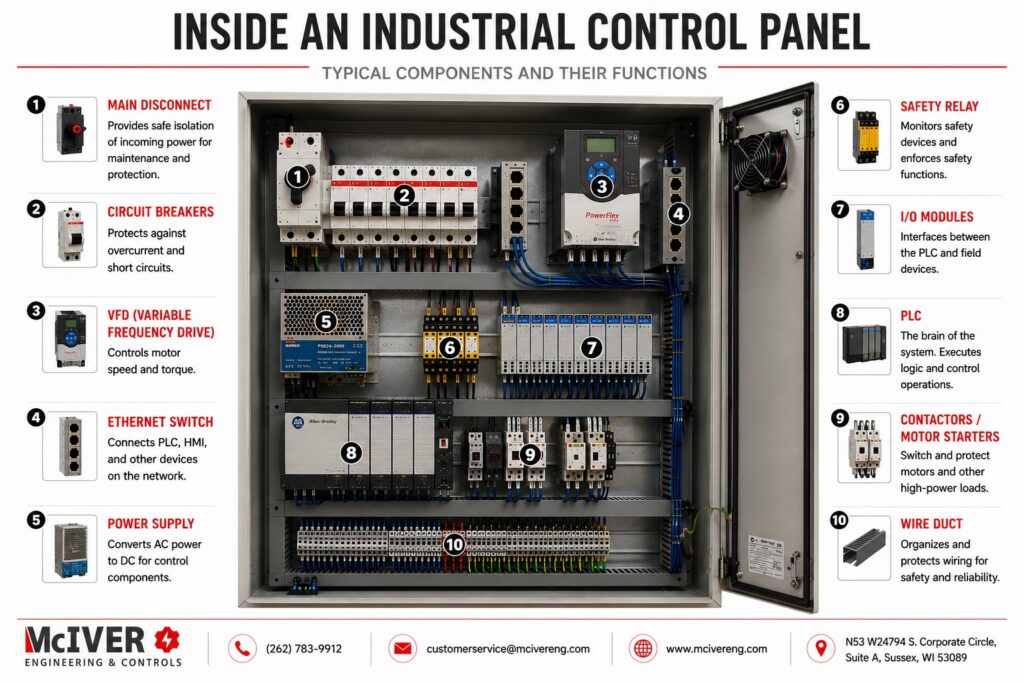
An industrial control panel is an electrical enclosure containing components that monitor, control, protect, and automate industrial equipment.
Depending on the application, a control panel may contain:
- PLCs
- Variable frequency drives
- Circuit breakers
- Power supplies
- Relays
- Terminal blocks
- Motor starters
- Ethernet switches
- Safety relays
- HMIs
- Industrial networking equipment
Together, these components coordinate machinery, communicate with sensors, and safely distribute electrical power throughout the automation system.
Unlike residential electrical panels, industrial control panels are designed specifically for manufacturing environments where reliability, safety, and continuous operation are essential.
Type 1: PLC Control Panels
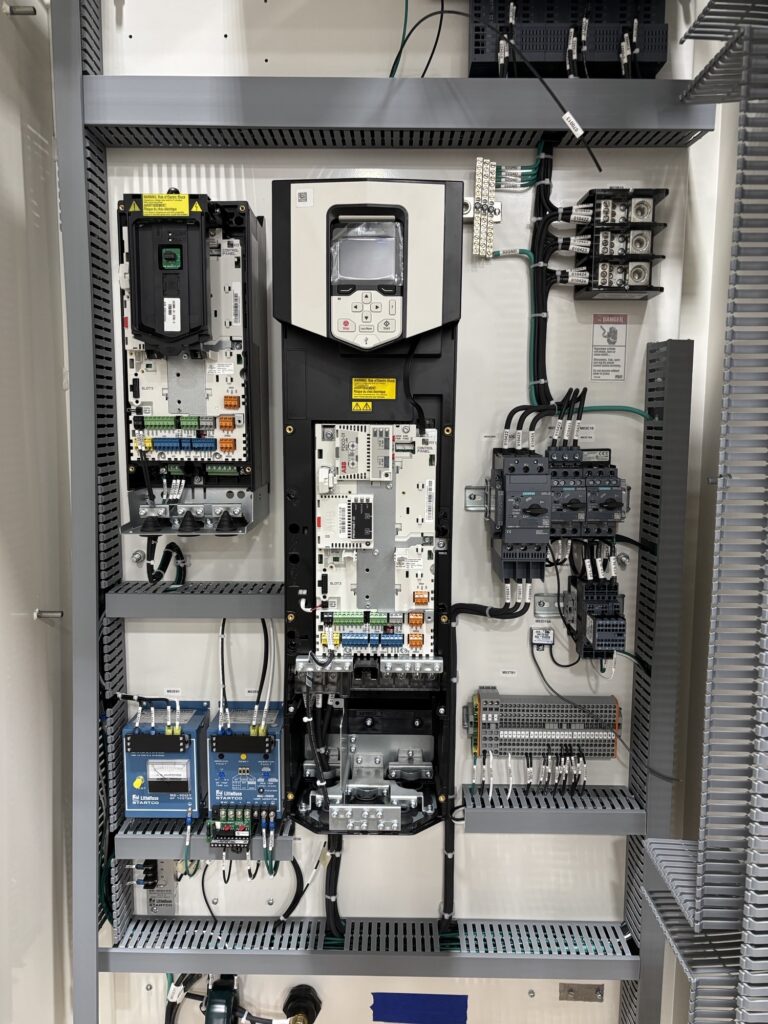
A PLC (Programmable Logic Controller) control panel is often considered the brain of an automated manufacturing system.
Instead of relying on mechanical relays, PLCs continuously receive information from sensors, evaluate programmed logic, and instantly send commands to motors, valves, conveyors, robots, or other equipment.
For example, on a packaging line, the PLC might monitor product position, verify labeling, communicate with robotic pick-and-place systems, and stop the entire line if a safety device is triggered.
Imagine a bottling line producing 250 bottles per minute. A PLC receives signals from photoelectric sensors, verifies bottle spacing, tells servo motors when to index the conveyor, coordinates robotic pick-and-place systems, and immediately stops the line if a safety gate opens. Hundreds of these decisions happen every second without operator intervention.
Common components include
- PLC processor
- Digital I/O modules
- Analog I/O modules
- Power supplies
- Ethernet switches
- Safety relays
- Circuit protection
- Terminal blocks
Typical applications
- Manufacturing lines
- Packaging equipment
- OEM machinery
- Robotics
- Material handling
- Assembly systems
Advantages
- Highly flexible
- Easy to modify
- Expandable
- Supports Industry 4.0 connectivity
- Integrates with SCADA and MES systems
Best suited for
Facilities requiring intelligent machine control, production flexibility, and future scalability.
Type 2: Motor Control Centers (MCCs)
If a PLC panel is the brain of an automation system, a Motor Control Center (MCC) is the heart that distributes and manages electrical power to multiple motors throughout a facility.
Instead of installing separate motor starters throughout a plant, an MCC consolidates them into a centralized cabinet system. This approach simplifies maintenance, improves organization, and provides operators with a single location to monitor and control motor-driven equipment.
You’ll commonly find MCCs in facilities operating dozens or even hundreds of electric motors, where centralized management improves both reliability and safety.
What is a Motor Control Center?
A Motor Control Center is a modular electrical assembly designed to safely distribute power and control multiple electric motors from one location.
Each section of an MCC typically contains:
- Motor starters
- Circuit breakers
- Disconnect switches
- Overload protection
- Power distribution busbars
- Variable Frequency Drives (when required)
- Communication modules
- PLC integration
Modern MCCs often communicate directly with PLCs and plant-wide automation networks, allowing operators to monitor motor performance remotely and receive instant fault notifications.
Typical applications
Motor Control Centers are commonly used in:
- Food and beverage manufacturing
- Water and wastewater treatment
- Material handling systems
- Mining operations
- Pulp and paper mills
- Automotive manufacturing
- Large packaging facilities
- Chemical processing plants
Anywhere dozens of motors need to operate together, an MCC is often the preferred solution.
Advantages
An MCC provides several operational benefits:
- Centralized motor management
- Reduced electrical room clutter
- Simplified maintenance
- Easier troubleshooting
- Improved personnel safety
- Scalable architecture
- Better documentation
- Easier future expansion
When is an MCC the right choice?
An MCC is ideal when your facility includes:
- Numerous conveyors
- Multiple pumps
- Large fan systems
- Compressors
- Mixers
- Production lines with many independently controlled motors
If your operation only requires one or two motors, a dedicated motor starter panel is often the more practical and cost-effective solution.
Type 3: Variable Frequency Drive (VFD) Control Panels
Not every motor should run at full speed all the time.
In many manufacturing applications, slowing a motor down by even a small amount can significantly reduce energy consumption, improve product quality, and extend equipment life.
That’s exactly what a Variable Frequency Drive (VFD) control panel is designed to do.
Rather than simply switching a motor on or off, a VFD continuously adjusts motor speed to match the actual process demand.
Imagine a conveyor transporting fragile products.
Starting the conveyor instantly at full speed could cause products to shift or become damaged.
A VFD allows the conveyor to accelerate smoothly, maintain an exact operating speed, and slow down gradually when production stops.
The same principle applies to pumps, fans, mixers, blowers, and countless other industrial systems.
What is a VFD Control Panel?
A Variable Frequency Drive control panel contains one or more VFDs that regulate the frequency and voltage supplied to electric motors.
By adjusting electrical frequency, the VFD controls motor speed with remarkable precision.
Typical components include:
- Variable Frequency Drives
- Circuit breakers
- Disconnect switches
- Harmonic filters
- Line reactors
- PLC integration
- Cooling systems
- Network communication devices
Typical applications
VFD panels are commonly found in:
- Conveyor systems
- HVAC equipment
- Pump stations
- Water treatment facilities
- Fans and blowers
- Mixing systems
- Packaging equipment
- Material handling systems
Advantages
Manufacturers choose VFD panels because they offer:
- Lower energy consumption
- Reduced mechanical wear
- Longer motor life
- Improved process control
- Smoother machine operation
- Lower maintenance costs
- Reduced electrical demand spikes
In facilities with large motors running continuously, energy savings alone can often justify the investment over time.
When is a VFD panel the right choice?
A VFD panel is an excellent choice whenever a motor’s speed needs to vary based on production requirements.
If a motor always operates at one constant speed, a standard motor starter may be sufficient.
However, if your process benefits from adjustable speed, controlled acceleration, or precise positioning, a VFD panel typically provides a better long-term solution.
Type 4: Human-Machine Interface (HMI) Panels
Behind every automated production line is someone responsible for keeping it running.
Operators need to know what machines are doing, when alarms occur, and how to safely make adjustments without opening electrical enclosures or accessing PLC programming.
That’s where Human-Machine Interface (HMI) panels play a critical role.
Rather than exposing operators to complicated control logic, an HMI presents information in a simple, visual format using industrial touchscreens.
Modern HMI panels have become the window into an entire manufacturing operation.
With a few taps, operators can monitor production rates, acknowledge alarms, review trends, adjust machine settings, and quickly identify problems before they become costly downtime events.
What is an HMI panel?
An HMI panel provides the graphical interface between people and automated equipment.
Although it doesn’t perform the control logic itself, it communicates directly with PLCs and other automation devices to display real-time information and accept operator commands.
Typical HMI features include:
- Industrial touchscreen display
- Production dashboards
- Alarm management
- Equipment status
- Recipe management
- Data trending
- User login security
- Maintenance diagnostics
Typical applications
HMI panels are used across virtually every automated industry, including:
- Food processing
- Pharmaceutical manufacturing
- Packaging lines
- Robotic cells
- Machine tending
- Assembly automation
- Material handling
- Process manufacturing
Advantages
An HMI improves operations by providing:
- Real-time machine visibility
- Faster troubleshooting
- Easier operator training
- Improved production monitoring
- Better alarm management
- Reduced downtime
- Enhanced maintenance support
Rather than searching for indicator lights or opening control cabinets, operators can quickly identify exactly where an issue exists.
When is an HMI panel the right choice?
Any automated machine that requires routine operator interaction will benefit from an HMI.
Whether it’s starting production, adjusting recipes, monitoring alarms, or reviewing machine performance, HMIs make sophisticated automation significantly easier to operate safely and efficiently.
Type 5: Motor Starter Panels
Not every machine requires the complexity of a PLC or the flexibility of a Variable Frequency Drive.
Sometimes, the goal is straightforward: safely start a motor, protect it from overload, and stop it when needed.
That’s where a motor starter panel excels.
Although motor starter panels are among the simplest industrial control panels, they remain one of the most widely used. You’ll find them controlling pumps, exhaust fans, compressors, dust collectors, mixers, and countless other pieces of industrial equipment.
For many applications, simplicity is actually an advantage. Fewer components often mean easier maintenance, lower costs, and excellent long-term reliability.
What is a Motor Starter Panel?
A motor starter panel is designed to safely start and stop one or more electric motors while protecting them from electrical damage.
Unlike a VFD, it does not regulate motor speed. The motor simply operates at its rated speed whenever it is running.
Typical components include:
- Magnetic contactors
- Overload relays
- Circuit breakers
- Disconnect switches
- Push buttons
- Selector switches
- Indicator lights
- Terminal blocks
Some motor starter panels also communicate with a PLC, allowing motors to be monitored remotely while still using relatively simple hardware.
Typical applications
Motor starter panels are commonly used for:
- Pumps
- Exhaust fans
- Dust collection systems
- Air compressors
- Cooling towers
- Hydraulic power units
- Mixers
- Stand-alone machinery
Advantages
Motor starter panels offer several benefits:
- Simple operation
- Lower installation cost
- High reliability
- Easy troubleshooting
- Minimal maintenance
- Excellent for fixed-speed motors
When is a motor starter panel the right choice?
Choose a motor starter panel when:
- The motor always runs at full speed.
- Variable speed isn’t necessary.
- Simplicity and reliability are priorities.
- Energy savings from speed control are minimal.
If the application requires precise speed control, soft starts, or changing production rates, a VFD panel is usually the better solution.
Type 6: Hazardous Location Control Panels
Some manufacturing environments present challenges that go far beyond standard industrial conditions.
Facilities processing flammable gases, combustible dust, solvents, or explosive materials require equipment specifically designed to prevent ignition and operate safely under hazardous conditions.
In these environments, a standard industrial control panel simply isn’t enough.
Hazardous location control panels are engineered to meet strict electrical and safety standards that help protect both personnel and equipment.
What is a hazardous location control panel?
A hazardous location control panel is designed for installation in areas where explosive gases, vapors, or combustible dust may be present.
Depending on the application, these panels may include:
- Explosion-proof enclosures
- Purged and pressurized systems
- Intrinsically safe circuits
- Corrosion-resistant materials
- Specialized cable entries
- Environmental sealing
- Certified electrical components
These panels are engineered to comply with applicable electrical codes and hazardous area classifications.
Typical applications
Hazardous location panels are commonly found in:
- Oil and gas facilities
- Chemical processing plants
- Grain handling operations
- Ethanol production
- Paint manufacturing
- Pharmaceutical production
- Mining operations
- Fuel storage facilities
Advantages
Hazardous location panels provide:
- Enhanced personnel safety
- Regulatory compliance
- Reliable operation in harsh environments
- Reduced ignition risk
- Long equipment life
- Protection against corrosive conditions
When is a hazardous location panel required?
If your facility contains:
- Flammable vapors
- Combustible dust
- Explosive gases
- Hazardous chemicals
your electrical equipment should be evaluated against the applicable hazardous area classifications before installation.
Because these environments involve specialized engineering and compliance requirements, hazardous location control panels should always be designed and built by experienced professionals familiar with the applicable codes and certifications.
Type 7: Remote I/O Panels
As manufacturing facilities become larger and more connected, running hundreds or even thousands of individual wires back to one central control panel becomes increasingly expensive and difficult to maintain.
Remote I/O panels solve this problem by distributing control hardware throughout the facility.
Instead of bringing every sensor and motor back to one cabinet, Remote I/O panels collect information locally and communicate with the main PLC over an industrial network.
The result is a cleaner, more scalable automation architecture.
What is a Remote I/O panel?
A Remote I/O panel contains input and output modules installed closer to the equipment they control.
Rather than direct wiring to the PLC, these panels communicate using industrial Ethernet or other automation communication protocols.
Typical components include:
- Remote I/O modules
- Ethernet switches
- Network communication cards
- Power supplies
- Terminal blocks
- Surge protection
Typical applications
Remote I/O panels are common in:
- Automotive manufacturing
- Distribution centers
- Large production facilities
- Packaging systems
- Material handling
- Process industries
- Airport baggage systems
- Warehouse automation
Advantages
Remote I/O architectures offer several benefits:
- Reduced wiring costs
- Faster installation
- Easier expansion
- Simplified troubleshooting
- Improved scalability
- Better network organization
For very large facilities, Remote I/O can significantly reduce installation labor while making future equipment additions much easier.
Type 8: UL 508A Industrial Control Panels
Regardless of the panel type, one certification often stands out above all others in North American manufacturing: UL 508A.
While UL 508A is not a type of control panel by itself, it represents one of the most important quality and safety standards for industrial control panels.
Manufacturers, OEMs, system integrators, and engineering firms frequently specify UL 508A-certified panels because they provide confidence that the panel has been designed and built in accordance with recognized safety requirements.
What is UL 508A?
UL 508A is the Underwriters Laboratories standard that governs the construction of industrial control panels.
It establishes requirements for areas such as:
- Component selection
- Short-circuit current ratings (SCCR)
- Wire sizing
- Overcurrent protection
- Panel labeling
- Electrical spacing
- Documentation
- Overall construction practices
Panels built by a certified UL 508A panel shop are manufactured under an audited quality program and follow documented engineering procedures.
Why does UL 508A matter?
Choosing a UL 508A-certified panel can help:
- Improve electrical safety
- Simplify inspections
- Meet customer specifications
- Support insurance requirements
- Reduce project risk
- Increase confidence in long-term reliability
For many manufacturers and OEMs, UL 508A certification is not just a preference. It is a project requirement.
Learn more: Everything You Need to Know About UL 508A Control Panels (Internal link)
Type 9: Operator Stations & Local Control Panels
Not every piece of industrial equipment needs a sophisticated touchscreen interface or a large centralized control panel.
Sometimes, operators simply need a safe and convenient way to start a motor, stop a conveyor, reset an alarm, or place a machine into maintenance mode while standing next to the equipment.
That’s exactly where operator stations and local control panels provide value.
These compact control stations bring essential controls directly to the point of operation, allowing personnel to safely interact with equipment without walking back to a central control room or opening an electrical enclosure.
Although they’re often smaller than other industrial control panels, operator stations play an important role in improving safety, reducing response times, and making equipment easier to operate.
What Are Operator Stations and Local Control Panels?
Operator stations and local control panels are compact control enclosures installed directly on or near industrial equipment.
Rather than housing the primary automation controller, these panels provide operators with the controls and indicators needed for everyday machine operation.
Depending on the application, they may communicate directly with a PLC, Motor Control Center (MCC), Variable Frequency Drive (VFD), or a larger control system.
Their primary purpose is to provide safe, convenient local control while the main automation logic remains inside the primary control panel.
Typical Components
Operator stations typically include:
- Start and stop push buttons
- Emergency stop (E-Stop) buttons
- Selector switches
- Pilot lights and status indicators
- Audible alarms
- Local HMI touchscreens (optional)
- Key-operated switches
- Hand-Off-Auto (HOA) switches
- Potentiometers or speed control knobs
- Terminal blocks and communication wiring
Depending on the application, local control panels may also include small PLCs, remote I/O modules, or Ethernet communication devices.
Typical Applications
Operator stations and local control panels are commonly used for:
- Conveyor systems
- Pump stations
- Packaging equipment
- Material handling systems
- Robotic work cells
- Machine tending applications
- Mixing and batching systems
- Process skids
- Assembly workstations
- Maintenance control stations
They’re especially valuable wherever operators need immediate access to machine controls without leaving the work area.
Advantages
Operator stations provide several operational benefits:
- Faster operator response
- Improved machine safety
- Easier equipment operation
- Reduced travel between equipment and control rooms
- Simplified maintenance activities
- Better operator visibility
- Flexible installation locations
- Lower installation costs compared to larger control cabinets
By placing controls where operators actually work, facilities can improve productivity while reducing unnecessary movement throughout the production area.
When Are Operator Stations the Right Choice?
Operator stations are ideal when:
- Operators frequently interact with equipment.
- Local start and stop controls are required.
- Maintenance personnel need safe local operation.
- Equipment is spread across a large facility.
- Quick access to emergency controls is important.
- Machines require manual operation during setup or troubleshooting.
In many facilities, operator stations work alongside PLC panels, MCCs, HMIs, and Remote I/O systems to create an automation architecture that is both efficient and user-friendly.
Real-World Example
Imagine a packaging line stretching more than 300 feet across a manufacturing facility.
The main PLC control panel is located in an electrical room, while multiple conveyors, palletizers, and inspection stations are distributed throughout the line.
Rather than forcing operators to return to the main control cabinet every time they need to start, stop, or reset equipment, local operator stations are installed at key points along the production line.
An operator can safely stop a conveyor to clear a jam, place equipment into maintenance mode, or restart a section of the line within seconds. Meanwhile, the PLC continues coordinating the overall process, ensuring all machines communicate and operate together safely.
This combination of centralized automation and localized control improves productivity, enhances operator safety, and reduces downtime during normal production and maintenance activities.
Type 10: Custom Industrial Control Panels: When Standard Solutions Aren’t Enough
A custom industrial control panel is designed and built specifically for a customer’s application rather than following a standardized design. Every aspect of the panel is carefully engineered to match the machinery it controls, the environment in which it operates, and the performance expected from the overall system.
Unlike off-the-shelf solutions, custom control panels are developed around the unique requirements of a manufacturing process. This allows engineers to optimize the panel’s layout, functionality, safety features, and communication capabilities while ensuring seamless integration with existing equipment.
Depending on the application, a custom industrial control panel may incorporate a wide range of technologies, including programmable logic controllers (PLCs), human-machine interfaces (HMIs), variable frequency drives (VFDs), motor starters, Remote I/O, safety PLCs and safety relays, servo drives, vision system interfaces, industrial networking equipment, power distribution components, and data collection and communication systems.
By integrating these technologies into a single, cohesive solution, manufacturers can simplify installation, improve system organization, reduce maintenance complexity, and create an automation platform that is easier to operate, troubleshoot, and expand as production needs evolve.
A custom panel may integrate multiple technologies into one organized solution, including:
- PLCs
- Human-Machine Interfaces (HMIs)
- Variable Frequency Drives (VFDs)
- Motor starters
- Remote I/O
- Safety PLCs and safety relays
- Servo drives
- Vision system interfaces
- Industrial networking equipment
- Power distribution
- Data collection and communication systems
Instead of purchasing multiple standalone panels, manufacturers can often simplify installation and maintenance by integrating these technologies into one cohesive system.
Typical Applications
Custom industrial control panels are commonly used for:
- OEM machinery
- Automated production lines
- Robotic work cells
- Packaging systems
- Material handling equipment
- Vision inspection systems
- Machine tending applications
- Assembly automation
- Industrial training systems
- Process automation
- Test equipment
- Retrofit and modernization projects
Whenever equipment becomes too complex for a standard panel configuration, a custom-engineered solution often provides the best long-term value.
Advantages of a Custom Industrial Control Panel
Custom panels offer benefits that extend well beyond electrical control.
Designed Around Your Process
Every component is selected to support the specific application rather than fitting within a predefined design.
Easier Maintenance
Thoughtful component placement, organized wiring, and clear documentation make troubleshooting faster and reduce maintenance downtime.
Simplified Future Expansion
Additional I/O capacity, communication ports, and spare panel space can be incorporated during the initial design, making future upgrades significantly easier.
Better Integration
Custom panels can communicate with existing PLCs, HMIs, robotics, vision systems, SCADA platforms, and enterprise software, creating a unified automation environment.
Improved Reliability
Engineering decisions are based on how the system will actually operate, helping reduce unnecessary complexity and improving long-term performance.
Lower Lifecycle Costs
Although a custom panel may require a greater initial investment, it often reduces engineering changes, installation issues, maintenance costs, and future retrofit expenses.
A Real-World Example
Imagine a manufacturer adding a robotic palletizing system to an existing packaging line.
The facility already operates legacy PLCs, multiple conveyor vendors, barcode scanners, safety devices, and warehouse software. A new robotic cell must communicate with all of these systems while maintaining production without disrupting existing operations.
Rather than installing several independent control panels, a custom industrial control panel can integrate the robot, conveyors, safety circuits, networking, operator interface, and production controls into one coordinated system.
The result is a cleaner installation, fewer communication challenges, easier maintenance, and a system that’s prepared for future expansion.
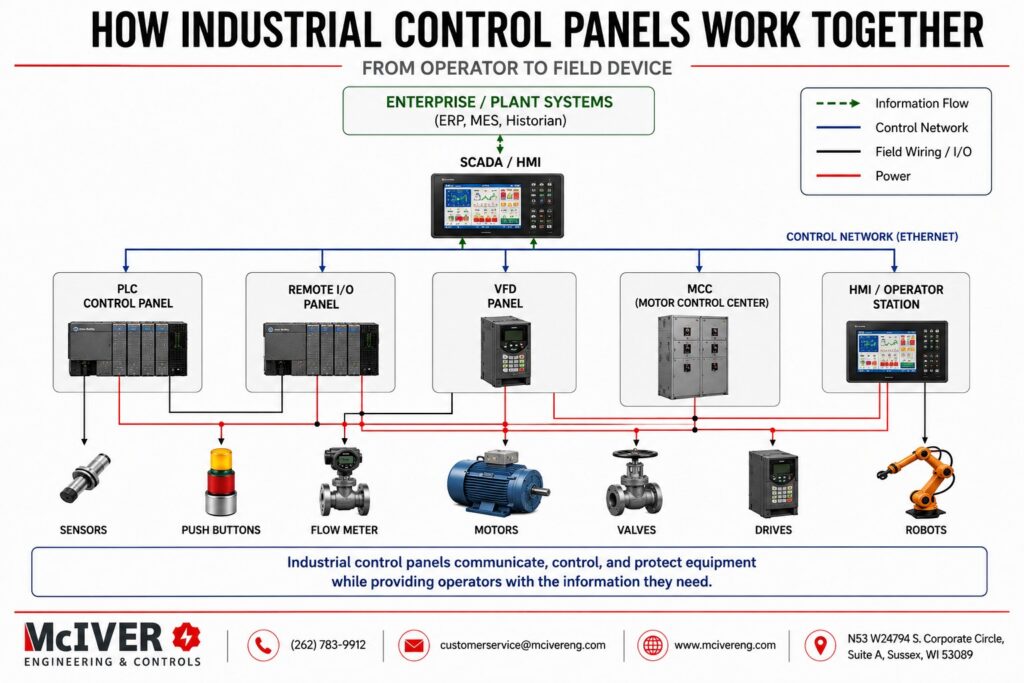
How Industrial Control Panels Work Together
Many people assume a manufacturing system contains one large control panel. In reality, most production lines use several different panel types working together.
For example:
|
Panel |
Role |
|
PLC Panel |
Controls the entire production line |
|
MCC |
Distributes power to dozens of motors |
|
VFD Panel |
Adjusts conveyor and pump speeds |
|
HMI Panel |
Allows operators to monitor and control production |
|
Remote I/O |
Connects sensors throughout the facility |
|
Motor Starter Panel |
Starts auxiliary equipment |
|
Custom Panel |
Integrates everything into one coordinated system |
Standard vs. Custom Industrial Control Panels
|
Feature |
Standard Panel |
Custom Panel |
|
Designed for a specific machine |
Limited |
✔ Yes |
|
Integrates multiple technologies |
Sometimes |
✔ Yes |
|
Future expansion |
Limited |
✔ Excellent |
|
Optimized layout |
Standard |
✔ Application-specific |
|
Engineering review |
Minimal |
✔ Included |
|
Mixed-vendor compatibility |
Limited |
✔ Excellent |
|
Best for |
Simple applications |
Complex manufacturing systems |
Industrial Control Panel Complexity Comparison
|
Panel Type |
Complexity |
Relative Cost |
Expandability |
Maintenance |
Best For |
|
Motor Starter Panel |
Low |
$ |
Low |
Easy |
Single motors and simple equipment |
|
Operator Station / Local Control Panel |
Low |
$ |
Low |
Easy |
Local machine operation and manual controls |
|
HMI Panel |
Low to Medium |
$$ |
Medium |
Easy |
Operator interaction and machine monitoring |
|
VFD Control Panel |
Medium |
$$ |
Medium |
Moderate |
Variable-speed motors and energy efficiency |
|
Remote I/O Panel |
Medium |
$$ |
High |
Moderate |
Large facilities and distributed control systems |
|
PLC Control Panel |
Medium to High |
$$$ |
High |
Moderate |
Automated machinery and production lines |
|
Hazardous Location Control Panel |
High |
$$$$ |
Medium |
Moderate |
Explosive or hazardous environments |
|
Motor Control Center (MCC) |
High |
$$$$ |
High |
Moderate |
Centralized control of multiple motors |
|
UL 508A Control Panel* |
Varies |
Varies |
Varies |
Varies |
Applications requiring certified industrial control panels |
|
Custom Industrial Control Panel |
Very High |
$$$$$ |
Excellent |
Designed for easy maintenance |
Complex manufacturing systems and OEM equipment |
*Note: UL 508A is a certification standard rather than a specific panel type. A UL 508A-certified panel can be a PLC panel, MCC, VFD panel, or a custom industrial control panel, depending on the application.
How McIver Engineering & Controls Approaches Custom Control Panels
At McIver Engineering & Controls, custom control panels are more than assembled electrical enclosures. They are engineered solutions built around each customer’s manufacturing objectives.
For more than 45 years, McIver has partnered with OEMs and manufacturers to design, build, and support custom industrial control panels for applications ranging from standalone machines to complex automated production systems. Every project benefits from experienced engineering, careful attention to detail, and a commitment to quality that helps customers improve reliability, simplify maintenance, and reduce project risk.
Whether the requirement is a UL 508A-certified control panel, an integrated automation system, or a complex multi-panel solution, McIver works closely with customers to deliver systems designed for long-term performance, safety, and scalability.
Key Takeaway
There is no such thing as a “one-size-fits-all” industrial control panel.
While standard panel designs work well for many applications, complex manufacturing environments often demand a solution engineered specifically for the process, the equipment, and the people who rely on it every day.
A custom industrial control panel brings together the right technologies into one coordinated system, helping manufacturers improve uptime, simplify maintenance, support future growth, and maximize the return on their automation investment.
Choosing an industrial control panel isn’t simply about selecting an enclosure or a list of components. It’s about designing a reliable control system that supports your production goals today while remaining flexible for tomorrow’s needs.
Whether you’re building new OEM equipment, expanding a production line, modernizing aging controls, or integrating robotics into your facility, understanding the strengths of each control panel type helps you make better engineering and investment decisions.
For straightforward applications, a standard panel may be all that’s required. For complex manufacturing environments, a custom-engineered solution often delivers better performance, easier maintenance, and lower long-term operating costs.
At McIver Engineering & Controls, we’ve spent more than 45 years helping manufacturers design and build industrial control panels that improve reliability, simplify operations, and support long-term growth. If you’re planning your next automation project, our engineering team can help you determine the right control solution for your application.
Frequently Asked Questions About Industrial Control Panels
What is an industrial control panel?
An industrial control panel is an electrical enclosure that houses the components used to control, monitor, and protect industrial machinery and automated processes. Depending on the application, it may contain PLCs, motor starters, VFDs, HMIs, relays, circuit breakers, power supplies, and industrial networking equipment.
What is the purpose of an industrial control panel?
Industrial control panels automate equipment operation, distribute electrical power, improve safety, protect electrical components, and allow operators to monitor and control manufacturing processes. They serve as the central control point for machines, production lines, and automated systems.
What are the most common types of industrial control panels?
The most common types include:
- PLC Control Panels
- Motor Control Centers (MCCs)
- Variable Frequency Drive (VFD) Panels
- Human-Machine Interface (HMI) Panels
- Motor Starter Panels
- Hazardous Location Control Panels
- Remote I/O Panels
- Operator Stations and Local Control Panels
- UL 508A Certified Control Panels
- Custom Industrial Control Panels
Each type is designed to solve a different operational challenge.
What is the difference between a PLC control panel and an MCC?
A PLC control panel controls machine logic by processing information from sensors and sending commands to equipment. A Motor Control Center (MCC) primarily distributes power and controls multiple electric motors. In many manufacturing facilities, PLC panels and MCCs work together as part of the same automation system.
What does a Variable Frequency Drive (VFD) do?
A Variable Frequency Drive controls the speed and torque of an electric motor by adjusting the electrical frequency supplied to it. VFDs help improve process control, reduce energy consumption, minimize mechanical wear, and extend equipment life.
When should I use a motor starter panel instead of a VFD?
A motor starter panel is typically the best choice when a motor operates at a constant speed and doesn’t require speed adjustment. If the application benefits from variable speed, controlled acceleration, or improved energy efficiency, a VFD control panel is generally the better solution.
What is an HMI panel?
A Human-Machine Interface (HMI) panel provides operators with a graphical interface for monitoring equipment, acknowledging alarms, viewing production information, and adjusting machine settings without directly interacting with the PLC programming.
What is Remote I/O?
Remote I/O allows input and output devices to be installed closer to the equipment they control rather than wiring everything back to one central control panel. This reduces wiring costs, simplifies installation, and makes future expansion easier.
What is a custom industrial control panel?
A custom industrial control panel is designed specifically for a customer’s equipment, production process, and operational requirements. It can integrate multiple automation technologies into a single, coordinated solution that improves reliability, scalability, and long-term maintainability.
What industries use industrial control panels?
Industrial control panels are used across many industries, including:
- Manufacturing
- Food and beverage
- Automotive
- Material handling
- Packaging
- Water and wastewater
- Chemical processing
- Pharmaceuticals
- Mining
- Aerospace
- OEM machinery
- Energy and utilities
What components are commonly found inside a control panel?
A modern industrial control panel may include:
- PLCs
- Power supplies
- Circuit breakers
- Relays
- Terminal blocks
- VFDs
- Motor starters
- Safety relays
- Ethernet switches
- HMIs
- Industrial communication devices
The exact configuration depends on the application.
Do all industrial control panels require UL 508A certification?
Not every project requires UL 508A certification. However, many manufacturers, OEMs, engineering firms, and end users specify UL 508A-certified control panels because they demonstrate compliance with recognized safety and construction standards.
What is SCCR?
SCCR stands for Short-Circuit Current Rating. It indicates the maximum fault current an industrial control panel can safely withstand under specified conditions. Selecting an appropriate SCCR is an important part of electrical safety and system design.
Can an existing control panel be upgraded instead of replaced?
In many cases, yes. Existing control panels can often be modernized by replacing obsolete PLCs, adding new communication hardware, upgrading HMIs, or incorporating additional safety features. The feasibility depends on the condition of the existing equipment and the goals of the project.
How long does an industrial control panel typically last?
The lifespan of an industrial control panel varies depending on the operating environment, maintenance practices, component quality, and technology lifecycle. While many panels remain in service for decades, aging electronics or obsolete components may eventually make modernization a more practical option than repair.
How do I know which control panel is right for my application?
Choosing the right control panel depends on several factors, including:
- The type of equipment being controlled
- Number of motors
- Required automation level
- Operator interaction
- Safety requirements
- Future expansion plans
- Environmental conditions
- Regulatory requirements
Working with an experienced control panel manufacturer can help ensure the solution aligns with both current and future operational needs.
What information should I have before requesting a quote?
Providing the following information can help speed up the design and quoting process:
- Equipment description
- Electrical drawings (if available)
- PLC platform preference
- Voltage requirements
- Number of motors and I/O points
- Safety requirements
- Environmental conditions
- Project timeline
- Applicable standards or certifications
Can a custom control panel support future expansion?
Yes. One of the primary advantages of a custom industrial control panel is that it can be designed with spare I/O capacity, communication ports, panel space, and power distribution to accommodate future equipment additions or production growth.
Why is documentation important for industrial control panels?
Accurate electrical drawings, bills of materials, wiring diagrams, and panel documentation simplify maintenance, reduce troubleshooting time, support future modifications, and help keep equipment operating safely throughout its lifecycle.
Why choose McIver Engineering & Controls for custom industrial control panels?
With more than 45 years of experience, McIver Engineering & Controls designs and builds custom industrial control panels that help manufacturers improve reliability, simplify maintenance, and support long-term operational success. From UL 508A-certified and UL 698A certified panels to fully integrated automation systems, McIver works closely with OEMs and manufacturers to deliver solutions tailored to each application’s unique requirements.